
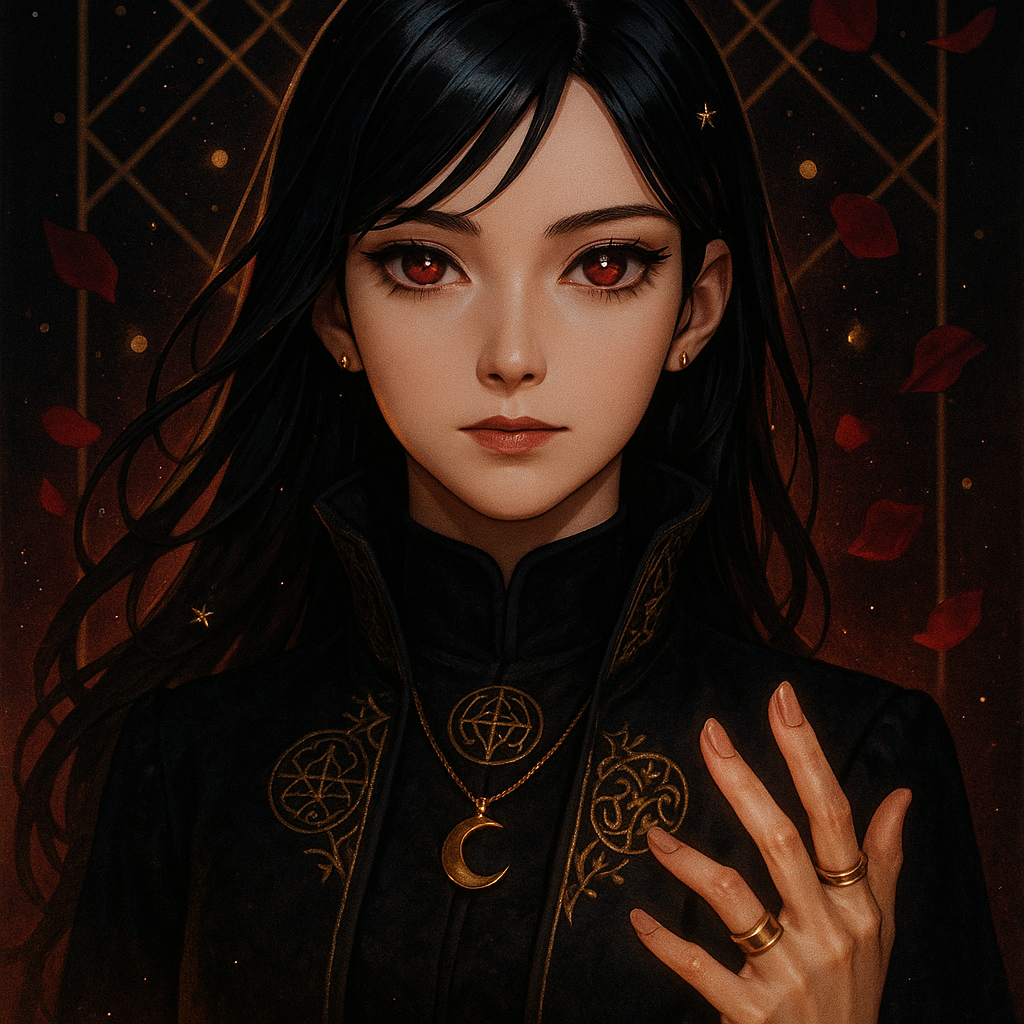
The Witch's craft is, in the most literal sense, a craft: a set of skills developed through deliberate practice that produces specific effects in both the practitioner and their partner. Atmosphere, ritual, and the sensory construction of the scene world are not incidental to what the Witch does; they are the primary medium through which the archetype operates.
Atmosphere as the Primary Medium
Many Dominant archetypes work primarily through words and actions. The Witch works primarily through atmosphere. Before a word of instruction is delivered, the scene space itself has already done significant work: the smell of the room, the quality and color of the light, the specific objects present, the music or silence, all communicate something about the world being entered and the authority of the person who created it. A Witch who understands this invests as much care in the preparation of the space as in the content of the scene.
Atmosphere construction is a specific skill. It involves understanding how sensory inputs interact, how the combination of candlelight and a particular herbal scent and a low and specific musical undertone creates a particular quality of psychological state in a person who enters the space. It involves choosing carefully and removing as much as adding: the cluttered ordinary room is not transformed by adding candles. The space needs to become genuinely different from the ordinary world, and that requires deliberate curation.
The most effective Witch atmospheres are those that are genuinely inhabited rather than assembled for the occasion. A practitioner who has developed their aesthetic environment over time, who keeps meaningful objects in their space not as scene props but as genuine expressions of their world, creates an atmospheric foundation that scene preparation builds on rather than creates from scratch. This is one reason why many Witches describe the archetype as a lifestyle dimension as much as a scene dimension.
Ritual Construction
Ritual in the Witch context is not ceremony for its own sake; it is a deliberate technology for shifting psychological states. A well-constructed ritual creates a threshold experience that marks the transition from ordinary reality into the enchanted space of the scene. The specific elements of the ritual, the actions performed, the words spoken, the objects used, serve to concentrate attention, shift neurological state, and establish the authority of the person who designed and leads the ritual.
Constructing an effective ritual requires understanding what each element is doing. The lighting of candles is not merely atmospheric decoration; the act of lighting them, performed with intention and focus, initiates the ritual time. The use of a specific scent, particularly one associated with the Witch's practice, triggers the conditioned response in a regular partner that says: we are entering that world now. The speaking of specific words, consistently associated with the opening of scenes, creates a Pavlovian anchor that deepens with repetition.
Rituals that are genuinely effective are usually relatively simple rather than elaborate. Complexity can diffuse attention rather than concentrate it. A ritual with three or four deliberate, meaningful elements, each carried out with full attention, is more powerful than a complex ceremony that becomes a logistical exercise. The quality of attention brought to each element matters more than the quantity of elements.
- Atmosphere is the Witch's primary medium; the scene space itself communicates authority before a word is spoken.
- Atmosphere construction is a developed skill that involves choosing and removing elements as much as adding them.
- Ritual is a technology for shifting psychological states, not ceremony for its own sake; its elements should each be doing deliberate work.
- Simplicity in ritual construction often produces more powerful effects than elaborateness, because it concentrates rather than diffuses attention.
The Witch's Toolkit
The Witch's scene toolkit typically includes elements from several categories. Scent is one of the most powerful: specific herbs, incenses, or essential oils can have strong psychological effects and can function as anchors that reliably shift state. Light, particularly candlelight or low, colored light, changes the quality of visual attention in ways that support the enchanted frame. Sound, whether music, silence, or the Witch's own voice at a specific register and pace, is a major atmospheric element.
Physical objects carry symbolic and psychological weight in the Witch's work. Objects that have been associated with specific scenes, or that carry genuine meaning in the practitioner's aesthetic world, communicate something that a prop borrowed for the occasion cannot. Herbs, crystals, athames, mortar and pestle, candles of specific colors, written documents, and binding cords are among the traditional elements of witch practice that appear frequently in Witch kink scenes.
The Witch's voice is itself a primary tool. Pacing, volume, the specific cadence and register of speech, what is said and what is withheld: all of these shape the partner's experience of the Witch's authority. A Witch who speaks slowly and precisely, with genuine attention behind each word, creates a very different atmosphere from one who speaks at ordinary conversational pace. The voice, in the Witch context, is understood as a medium of power.
Theatrical Commitment
All of the craft elements described above depend on a quality of theatrical commitment that keeps the fiction genuinely alive through the full length of the scene. The Witch who pauses to apologize, who steps out of the atmospheric register to handle something logistical in an ordinary way, who allows the ordinary world to intrude without the fiction absorbing the intrusion, loses the enchanted quality of the scene in a way that is difficult to recover.
Theatrical commitment does not mean ignoring safety or genuine communication needs. It means developing the skill of handling ordinary necessities, including check-ins and adjustments, within or adjacent to the fictional frame rather than shattering it. A Witch who checks in on her partner in the register of the scene, asking in character whether the binding is too tight, maintains the atmosphere through the check-in rather than breaking it. This skill is developed through experience and is one of the marks of a genuinely accomplished Witch practitioner.
Exercise
Scene Space Design
This exercise produces a specific, practical design for a Witch scene space that you can actually build and use.
- Choose a space you have access to and write down its current state: what is already in it, what the light quality is, what it smells like. This is your starting point.
- Write down what needs to change to transform this space into the Witch's domain: what needs to be removed, what needs to be added, what needs to change in the light and the smell. Be specific: not 'make it more atmospheric' but 'remove the desk lamp and use three candles at specific positions, add sandalwood incense.'
- Identify the three most important sensory elements of your Witch's space, the ones that most reliably create the specific atmosphere you are going for, and make sure you have or can obtain each one.
- Design the entry ritual for this space: the specific sequence of actions that marks the transition from ordinary reality into scene space. Write each step in order and practice it alone before using it in a scene.
- Identify one element of your current scene space or ritual that is not genuinely yours, that you borrowed from somewhere without being sure it actually fits your Witch. Consider whether to keep it or replace it with something that is more genuinely your own.
Conversation starters
- What is the most important element of your Witch's scene space? What single thing, if removed, would most diminish the atmosphere?
- How do you think about the difference between ritual elements that are genuinely working and ones that have become rote?
- How do you handle ordinary necessities during a scene, check-ins, adjustments, logistical things, without breaking the atmospheric frame?
- What has your experience taught you about simplicity versus elaborateness in ritual? What is the most powerful scene you have created, and what did it contain?
Ways to connect with a partner
- Create the scene space together for at least one session and observe what your partner responds to most strongly. Their response is real-world feedback on which atmospheric elements are doing the most work.
- Ask your partner to tell you what element of the Witch's atmosphere they find most powerful, and what they find less effective or even jarring. This feedback is specific and useful in a way that general appreciation is not.
- Discuss the entry ritual explicitly: does it work for both of you as a threshold experience? What could make the transition feel even more deliberate and marked?
For reflection
What is the most genuinely yours in your Witch's scene craft: the element that comes most directly from your own aesthetic world rather than from a borrowed tradition or source?
Atmosphere and ritual are the Witch's primary forms of authority. The next lesson turns to the conversation that makes those scenes safe: how to negotiate Witch dynamics, what consent looks like in an atmospheric and suggestive framework, and how to discuss the role with a partner.